Collectors and foundations care about their records for many of the same reasons. What differs is who else those records have to satisfy. A foundation answers to a board, to an auditor, to the terms of its own charter, and often to a public that has some claim on what it holds. That widens what a collection record needs to do.
For a foundation, an inventory is not a personal reference tool. It is the evidence that the organisation knows what it holds, where it is, what it is worth, and how it came to be there. When a trustee asks how many works the foundation owns, or a registrar at a lending institution asks for a condition report, or an auditor asks for a valuation summary, the answer has to be available and defensible.
This article looks at why art inventory management matters differently for foundations, and how to build records that hold up over time.
What makes art inventory management different for foundations
Three pressures shape how a foundation keeps its records.
The first is accountability. Trustees carry a duty of care over the assets they oversee. That duty is difficult to discharge without a complete and current picture of the holdings. An incomplete inventory is not simply inconvenient, it is a governance gap.
The second is continuity. Foundations outlast the people who run them. Directors move on, trustees rotate, archivists retire. Anything known only to one person is lost the moment that person leaves. A foundation's records have to carry institutional memory on their own, without relying on anyone to remember the context.
The third is scrutiny. Foundations field a particular set of questions, many of them from outside the organisation. Provenance research, restitution enquiries, loan requests, tax and charitable status reviews, and scholarly access requests each place their own demands on documentation, and they usually arrive with a deadline attached.
Building art collection records that outlast staff changes
Records usually fail in a particular way. The artwork is there. The context around it is not.
A work is catalogued with an artist, a title and a date, but nothing records that it was acquired directly from the artist's studio, that a condition issue was addressed by a named conservator in 2019, or that a specific institution has asked to borrow it twice before. That knowledge sits with whoever handled it at the time, and it leaves when they do.
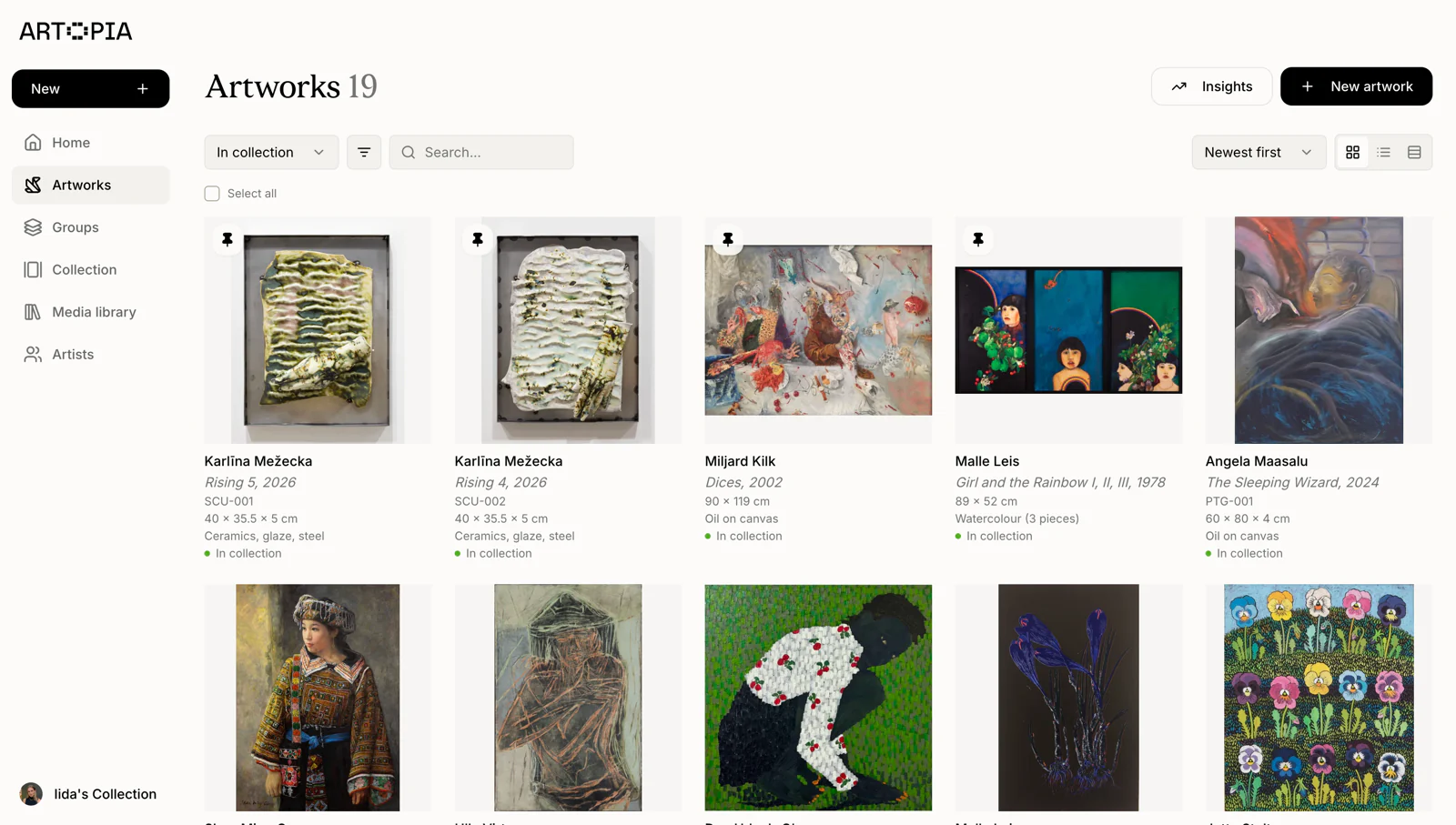
Good practice is to record the reasoning, not only the facts. Acquisition circumstances, prior loan history, conservation decisions, and any correspondence that explains why something was done all belong attached to the record itself rather than filed separately. In Artopia, documents can be attached directly to an individual artwork, so a certificate, an invoice, a condition report or a piece of correspondence lives with the work it relates to rather than in a folder someone has to know to look for.
Why provenance tracking is an ongoing obligation for foundations
Provenance gets much of its attention at acquisition and again at sale. A foundation usually has reasons to keep returning to it in between.
Provenance research is rarely finished. New scholarship emerges, gaps close, and a chain that looked complete a decade ago may need revisiting. A foundation's inventory should therefore treat provenance as something that grows rather than something entered once and left alone. Each entry should be dated and, where possible, tied to its supporting document, so a future researcher can see not only what is claimed but what it rests on.
This is the difference between a provenance line that reads as a list of names and one that can withstand a due diligence review. The first is a summary. The second is evidence.
Managing loans and access requests from your art inventory
Most foundations lend. Some exist primarily to lend. Either way, a loan request creates immediate documentation demands: current condition, accurate dimensions, insurance valuation, crating and handling notes, and high-resolution images suitable for a catalogue.
If those things are scattered, every loan becomes a research project. If they sit on the record, a loan becomes an administrative task. The media library keeps every image linked to its artwork and searchable, so a request for press-quality images does not mean hunting through drives, and PDF export turns a record into a shareable sheet without rebuilding it by hand.
There is also the question of visibility. Many foundations have a mandate to make holdings accessible for research, without wanting to publish everything indiscriminately. A public collection page allows a foundation to present a selected, well documented view of its holdings to curators and researchers, while keeping the full inventory private.
Reporting to trustees and auditors from your art collection records
What a board usually needs is a summary rather than the underlying records: how many works, in what categories, held where, valued at what, and what has changed since the last meeting.
That kind of reporting depends entirely on the underlying records being consistent. If medium is entered as "oil on canvas" in some records and "Oil/canvas" in others, no filter will group them reliably. If acquisition dates are missing on a third of the collection, no report on acquisition activity will be accurate.
Consistency in the underlying fields is what makes reporting straightforward later. Applied the same way across every record, it allows a foundation to filter and search its holdings and pull a reliable summary whenever one is asked for.
For handover to an auditor or a new director, exporting the full dataset with its associated media matters as well. A foundation should never be in a position where its records are trapped inside a system it cannot get them out of.
How to start managing your foundation's art inventory
If a foundation is building or rebuilding its inventory, the order of work matters more than the speed.
Begin with a complete list before a perfect one. Knowing that the foundation holds 340 works, even with thin records on many of them, is more useful than holding 40 immaculate records and an unknown remainder.
Standardise the fields next. Agree how medium, dimensions, and location will be written, and apply it consistently. Small inconsistencies compound quickly across a few hundred records, and are far harder to correct later than to prevent now.
Introduce a numbering system early. A stable internal identifier for each work makes every subsequent conversation clearer, whether that is a loan agreement, a condition report or an insurance schedule.
Attach documents as you go, rather than setting them aside for a separate digitisation project later. A record with its invoice and certificate attached is worth considerably more than a record with a note saying the paperwork exists somewhere.
Then work through the collection adding depth: provenance, condition history, exhibition record, images. This is the part that takes time, and it is the part that separates a list from an archive.
Art collection management software for foundations of any size
Artopia works for foundations of every size, and what changes is where the value lands.
Smaller foundations often see the most immediate gain. Many are still working from a spreadsheet, a shared drive and the knowledge of one or two people, with no dedicated system at all. For them, moving to structured records is not an incremental upgrade. It is the difference between an inventory that can answer a question and one that sends someone searching. A newly established foundation also has the advantage of setting its conventions correctly from the first record rather than correcting them across hundreds later.
Larger foundations tend to gain something different. The holdings are usually already documented somewhere, but the documentation is spread across systems, spreadsheets and folders built up over years by different people. The value there is consolidation: one place where the record, the images, the paperwork and the provenance sit together, so the answer to any question about a work is in a single view.
What serves both is the same underlying structure. Artwork records hold provenance and acquisition detail, documents attach at the artwork level, several collections can be managed from one account when a foundation holds distinct bodies of work, inventory numbering stays consistent across the whole catalogue, and everything exports cleanly in both PDF and data form.
The practical question is rarely which advanced module a system offers. It is whether the records are complete, consistent and accessible to whoever needs them next. That is a solvable problem at any scale, and the sooner it is addressed the less it costs.
Frequently asked questions
Why does a foundation need art inventory management software rather than a spreadsheet?
A spreadsheet handles the tabular part of an inventory well, and many foundations start there. What it cannot hold is the material that sits around each work: certificates, high-resolution images, provenance as a dated sequence, or a formatted condition sheet for a lender. As holdings grow and people change, more of what the organisation knows ends up living outside the spreadsheet than in it.
What should a foundation record for each artwork in its collection?
At minimum: artist, title, date, medium, dimensions, current location, acquisition source and date, and images. Beyond that, provenance, condition history, valuation history, and any supporting documents including invoices, certificates and conservation reports.
How should a foundation handle provenance research that is still incomplete?
Record what is known and mark what is not. An honest gap is more useful than a smoothed-over chain, both for future researchers and for any due diligence review. Date each entry so it is clear when the information was established.
Can several people manage the same art collection records?
Artopia supports managing multiple collections from a single account, which suits a foundation with distinct holdings. If your organisation needs several individual users working simultaneously with separate permissions, contact the team at hello@art-opia.com to discuss what is currently possible.
What is next
A foundation's inventory is its memory. It outlasts everyone who works on it, and its quality determines what the organisation is able to do: lend confidently, report credibly, research thoroughly, and pass on holdings in good order.
If you are starting that work, the get started guide covers the basics of building records in Artopia, and importing data explains how to bring an existing inventory across from a spreadsheet or another system.