Managing an art collection starts simply, but as it grows, many collectors turn to art collection management software to stay organised. Art collection management software helps you catalog artworks, store documents, track provenance, and manage your collection in one place.
Most collectors start informally. A note in your phone, a folder of photos, a rough spreadsheet. For a small collection, this works well enough. The act of recording your works matters more than the system you use to do it.
But collections grow, and the way you manage them needs to grow with them. The question is not whether dedicated software is better than informal tracking in the abstract. It is whether your collection has reached the point where informal tracking is actively working against you.
Here are the signs that it has.
Your collection has passed the point where you can hold it in your head
For most collectors, the turning point arrives somewhere between fifteen and thirty works. Below that threshold, you probably remember what you own, roughly what you paid, and where each piece came from. Above it, you start to lose the thread.
This is not a failure of memory. It is a natural consequence of collecting intentionally over time. When you can no longer picture your full collection without referring to notes, and those notes are scattered across devices and folders, you have already moved past the point where informal tracking serves you.
A dedicated art collection management system does not just store the information. It gives your collection a single home, so you are not reassembling the picture every time you need it. If you are still building your collection and figuring out your approach, our guide for emerging collectors covers the foundations worth getting right from the start.
You are preparing for insurance, and your records are not ready
Art insurance is one of the clearest signals that informal tracking has a real cost. Insurers need documentation: acquisition details, valuations, condition at time of purchase, provenance where available. If that information lives across old emails, invoices in a drawer, and photos on your phone, pulling it together for a policy review is a significant project. For a full breakdown of what collectors need to know, see our guide on art insurance for private collectors.
More importantly, if something happens to a work and your records are incomplete, you are negotiating a claim with gaps in your documentation. That is a position no collector wants to be in.
Good records are not something you build in response to an insurance requirement. They are something you maintain as you collect, so that when you need them, they are already there.
You have started lending works, or been asked to
Lending a work to an exhibition or a friend's project introduces a layer of complexity that informal tracking handles badly. You need a record of the work's condition before it leaves, documentation of where it is going and for how long, and a clear account of its return. Without that, you are relying on memory and goodwill.
If you have lent a work and felt uncertain about whether you had a proper condition record, or if you have been asked to lend and realized your documentation was not in order, that is the moment art collection software starts earning its place.
You have noticed gaps in your provenance records
Provenance matters more as collections mature. It affects value, it affects saleability, and in some cases it affects the legal standing of a work. The time to record provenance is at the point of acquisition, when the information is fresh and the seller is accessible.
If you look back at works you acquired even a few years ago and realize you no longer remember the full chain of ownership, or cannot locate the documentation that would support it, you are already experiencing the cost of deferred record-keeping. For a full overview of what provenance documentation involves and why it matters, see our article on art provenance for collectors.
Art collection management software does not solve gaps that already exist, but it prevents them from accumulating. Every acquisition documented at the time of purchase is one fewer gap to chase down later.
You are buying more actively, and acquisition is outrunning your records
There is a difference between a collector who acquires a few works a year and one who is buying regularly across fairs, galleries, and secondary market sources. The second collector is generating paperwork, correspondence, and documentation at a pace that informal systems struggle to absorb.
If you have ever found yourself with a stack of invoices you have not filed, a folder of photos you have not matched to records, or a gallery email you cannot locate when you need it, the system is not keeping up. This tends to get worse before it gets better, because the backlog compounds.
Starting a dedicated system at the point of active acquisition, rather than waiting until the backlog is unmanageable, is considerably easier.
You are thinking about your collection's future
Estate planning is not a comfortable subject, but it is one that every established collector eventually faces. A well-documented collection is easier to value, easier to divide, and easier to transfer than one where records are incomplete or scattered.
If you want the people who inherit or manage your collection to understand what you built, and to be able to act on it properly, the documentation needs to exist. A dedicated system that holds records, images, and documents for each work is the foundation for that.
When art collection management software becomes necessary
The collectors who find the transition to dedicated art collection software easiest are the ones who make it before the problem is acute. Not in response to a lost document or a stressful insurance claim, but at the point where they can see the informal system starting to strain.
If you recognise more than one of the situations above, that point is probably now. The records you create going forward will be complete. The works you document properly from acquisition will carry that documentation with them, permanently.
When you are ready to make the move, look for a tool built for collectors rather than galleries or institutions. Something that keeps artwork records, images, and documents together in one place, makes sharing straightforward when you need it, and gives you full ownership of your data. For a closer look at what that means in practice, see how dedicated software compares to a spreadsheet.
Artopia is art collection management software built for private collectors. If your collection has reached the point where it deserves a proper home, it takes a few minutes to get started.
Common questions about art collection software
When should I start cataloging my art collection?
The best time to start cataloging is at the point of acquisition, when details are fresh and documentation is easy to obtain. In practice, most collectors begin when informal records start to feel unmanageable, typically somewhere around fifteen to thirty works. Starting earlier is always better: retroactive documentation is harder and less complete than records built as you collect. If you are just getting started, our guide on how to catalog and document your art collection covers what to record and how.
What does art collection management software do?
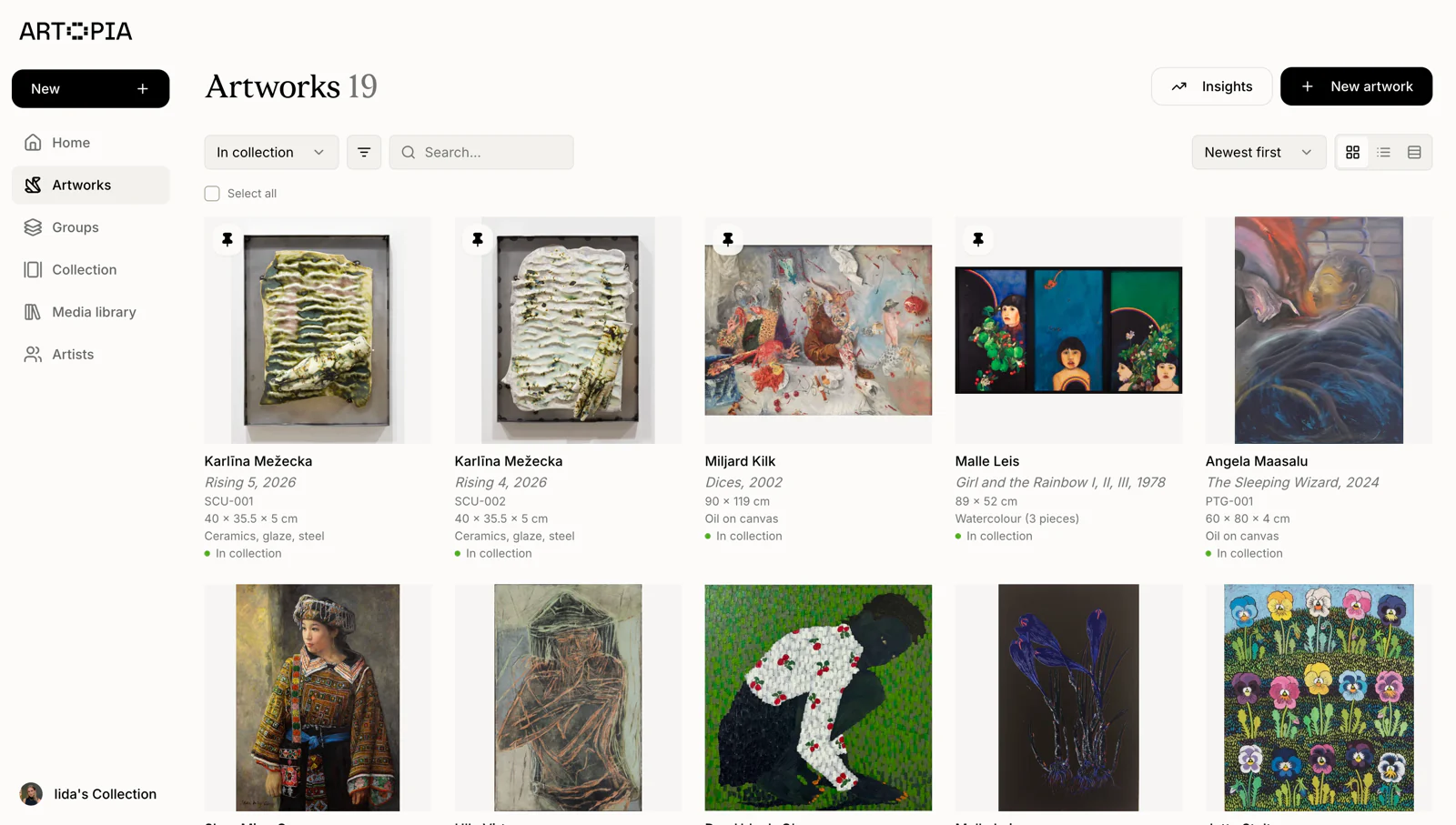
Art collection management software helps collectors catalog artworks, store images and documents, track provenance, and manage their collection in one place. A good tool keeps everything connected to the right work: acquisition details, certificates of authenticity, condition records, and valuation history. It also makes sharing and exporting your collection straightforward when you need to. You can see how Artopia handles this in the artwork records overview.
Can I manage an art collection in a spreadsheet or Excel?
Yes, and many collectors do, especially early on. Spreadsheets are free, familiar, and adequate for small collections. The limitation is that they hold text only: images, documents, and certificates have to live elsewhere, which means your records are always split across multiple places. As a collection grows, that separation becomes a real cost in time and completeness. For a full comparison, see art collection management: spreadsheet vs. dedicated software.