Art collection documentation is the process of creating a structured record for every artwork you own. These records typically include artist information, title, date, medium, dimensions, provenance, acquisition details, valuation, condition notes, and photographic documentation. Together, they form your art inventory: the authoritative reference for everything in your collection.
Cataloging an art collection is one of those things collectors tend to put off. There's always a more interesting task: finding the next work, arranging a loan, rethinking a wall. But a collection without solid records is harder to insure, harder to sell from, harder to pass on, and harder to understand as a whole. The good news is that building an art inventory isn't complicated. It just requires knowing what to record, and having somewhere consistent to record it.
This guide covers what cataloging artwork actually involves, what information matters most for each record, and how to build a documentation habit that holds up over time.
Why documentation matters more than most collectors expect
Most collectors start thinking seriously about documentation when something forces the issue: an insurance claim, an estate conversation, a request for a loan to an institution. By then, gaps in the record are already a problem.
Good documentation serves several distinct purposes:
Insurance and valuation. Insurers need to know what you own, what it's worth, and evidence of both. Without current valuations and purchase records, settling a claim becomes difficult. With them, it's straightforward.
Resale and consignment. When you decide to sell a work, the documentation you hold directly affects what a gallery or auction house can do with it. Gaps in provenance, missing certificates of authenticity, or unclear purchase history slow the process and can reduce what a work achieves.
Loans and exhibitions. Institutions requesting loans need condition reports, exhibition history, and publication records. A well-documented work is easier to lend and reflects well on the collector.
Estate and succession planning. For collections with any significant value, passing works to heirs or a foundation requires clear records. Without them, the process becomes legally and logistically complex.
Your own understanding. There's also a quieter reason: a documented collection is one you can actually think with. You can see how it has grown, trace the relationships between works, and make more considered decisions about what to acquire next.
What to record for each work
Cataloging artwork at the work level is the foundation of a good art inventory. For each piece in a collection, there's a core set of information worth capturing.
Identification
The basics: artist name, title, date of creation, medium, and dimensions. These seem obvious, but they're worth recording precisely and consistently. Dimensions should follow a standard format (height × width × depth, in centimeters or inches; pick one and stick with it). Medium should be specific enough to be useful: "oil on linen" rather than just "painting."
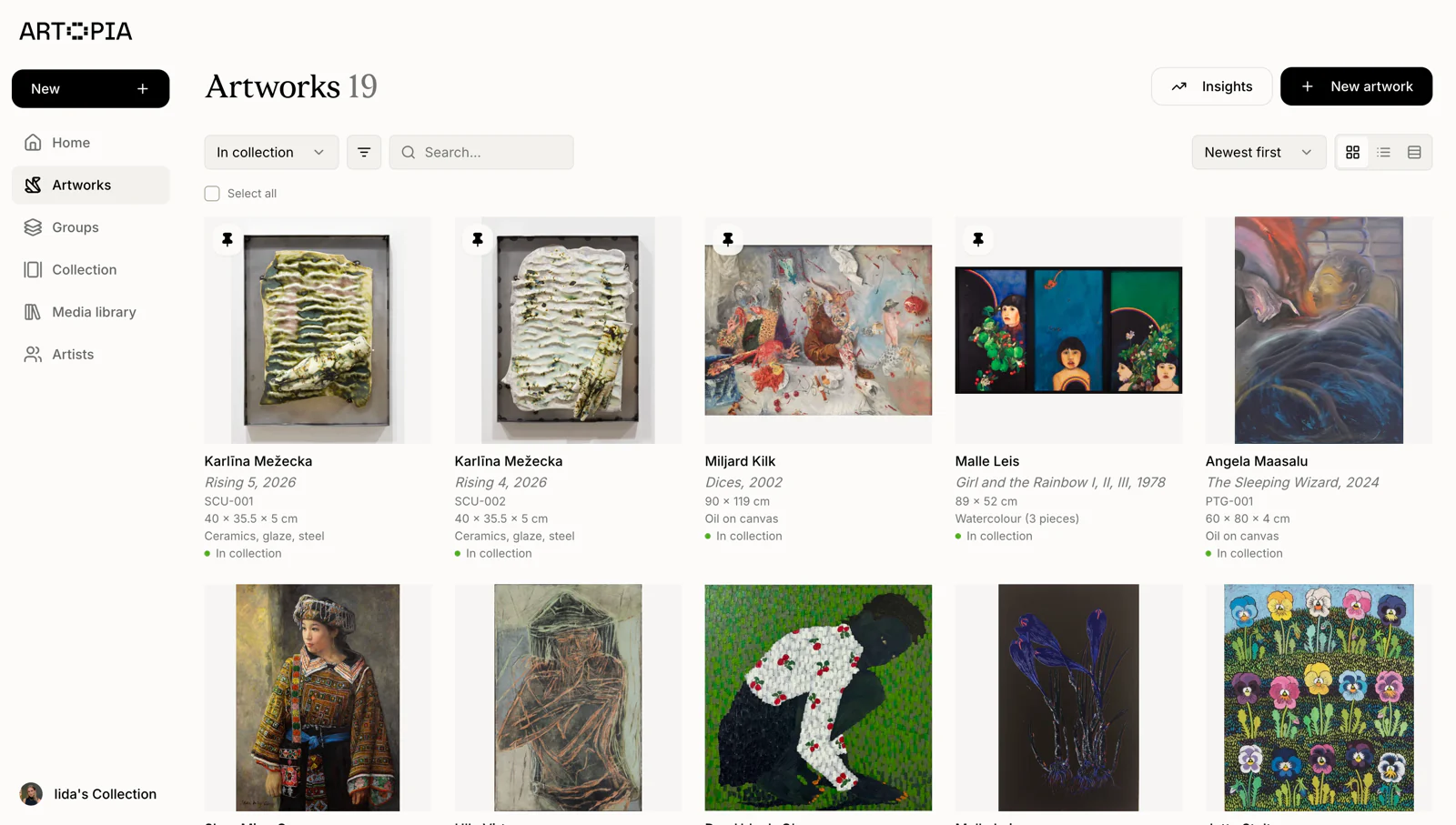
If the work has an artist's catalogue number, edition number, or any markings on the verso, those belong here too. Artwork records in Artopia are structured around these fields, making it straightforward to build a consistent record from the moment you acquire something.
Acquisition details
Where did you acquire the work, and when? From a gallery, an auction house, a private seller, or another collector? Record the source, the date, and the price paid. Keep a copy of the invoice or receipt attached to the record, not just for insurance purposes, but because this information is part of the work's provenance.
If you acquired the work as a gift or through an exchange, document that too. The circumstances of acquisition are part of the history of the object.
Provenance
Provenance is the ownership history of a work: who has owned it, and when. For some works this is simple: you bought it from the gallery that represents the artist, and that's the complete history. For older works or works that have passed through multiple hands, it can be more complex.
Record whatever you know. If the gallery or auction house provided provenance information at the time of sale, keep that documentation. If you've done your own research, note it. Provenance isn't just a bureaucratic requirement. It's part of what gives a work its integrity and, in some cases, its value.
Condition
A brief condition note at the time of acquisition is worth more than people realize. It establishes a baseline. If something changes (a crack appears, a repair becomes visible), you have a reference point. For significant works, a formal condition report from a conservator is worth commissioning.
Photograph condition issues specifically, not just the work as a whole. Close-ups of any damage, restoration, or unusual features give you evidence that written descriptions alone can't provide.
Documents and certificates
Certificates of authenticity, artist statements, gallery correspondence, exhibition catalogues, appraisals, import and export documents: all of these belong in the record for the work they relate to. Storing documents alongside the artwork record, rather than in a separate folder, means they're there when you need them rather than lost in a filing system.
For works that come with a certificate of authenticity, photograph or scan it and attach it digitally even if you're keeping the original in physical storage.
Photography
Photographic documentation is a part of the record that collectors often treat as secondary. It shouldn't be.
For each work, you want at minimum:
- A full-face shot in good, even light (no flash, no hard shadows)
- A shot of the verso, showing any markings, labels, or inscriptions
- A detail shot of the signature
- Any condition details worth capturing
You don't need professional photography for every work, though for significant pieces it's worth the investment. A careful photograph taken with a modern phone in good light is far better than nothing. The goal is a clear, accurate visual record, not an exhibition-quality image.
Store photographs with the work record, and name or tag them consistently so you can find them later.
Location and storage
Knowing where each work is at any given time sounds simple, but it becomes genuinely complicated as a collection grows. Works move: to storage, to framers, to conservators, to exhibitions, to loans. A record that doesn't track location is an incomplete record.
Note the current location of each work and update it when things move. For works in storage, be specific: which facility, which rack or bin if applicable. If a work is on loan, note who has it, under what agreement, and when it's due to return.
Building a documentation habit
The biggest challenge with collection documentation isn't knowing what to record. It's doing it consistently. Records that are created at acquisition and never updated are only half useful.
A few practices that help:
Document at acquisition. The moment you acquire a work is when you have the most information at hand: the invoice, the provenance statement, the certificate, the gallery's condition report. Capturing everything then, before the paperwork gets filed away, is far easier than reconstructing it later.
Review annually. A once-a-year pass through your records (checking that locations are current, valuations are up to date, and nothing is missing) keeps the collection record from drifting out of sync with reality. This is also a natural moment to commission new appraisals for works whose value may have changed.
Record changes as they happen. A work goes to a conservator, comes back with a treatment record. Note it. A work appears in an exhibition catalogue. Add it to the exhibition history. A new appraisal comes in. Update the value. These are small actions in the moment and significant contributions to the record over time.
Export and back up regularly. A collection record that exists in only one place is a risk. Exporting your data from Artopia takes a few clicks and gives you a backup you can store separately or share with an advisor, estate attorney, or family member who needs visibility into the collection.
How much detail is enough?
The honest answer is: more than most collectors currently have, and less than the theoretically perfect record that never gets finished.
A complete record for every work in your collection is the goal, but a partial record for all works is more useful than a perfect record for a few. Start with what you have. Fill gaps as you encounter them. Don't let the size of the task prevent you from starting.
For a new acquisition, the record should be substantially complete by the time the work is hung or in storage. For works you've owned for years without documentation, work backward using whatever you have: old invoices, correspondence with galleries, photographs. Auction records are publicly accessible and can help reconstruct provenance and prior sale prices.
Tools for managing an art collection
Once you decide to take your art inventory seriously, the next question is where to keep it. There are a few broad options, each suited to a different stage of a collection.
Spreadsheets. Many collectors start with a spreadsheet, and for a small collection it works reasonably well. You can set up columns for the fields that matter to you, and it costs nothing. The limits become apparent as a collection grows: there's no clean way to attach documents, version control is a persistent problem, sharing with an advisor requires exporting and emailing, and location tracking doesn't exist in any meaningful sense.
Museum collection systems. Software built for institutions (TMS, Mimsy, Axiell) is comprehensive but designed for professional registrars managing thousands of objects across multiple departments. For private collectors, these tools are expensive, complex, and more than the situation requires.
Dedicated collector software. Collection management software built specifically for private collectors sits between these two. It gives you structured records, document storage, location tracking, and proper data export, without the overhead of an institutional system.
If you're weighing spreadsheets against dedicated software in more depth, the art collection management: spreadsheet vs. dedicated software article covers the tradeoffs in detail.
Artopia is built for established and emerging collections: structured artwork records, document storage, location tracking, and clean data export whenever you need it. If you're managing more than a handful of works and the spreadsheet is starting to feel like the problem rather than the solution, it's worth trying it for free.
Good documentation doesn't make a collection. The works do. But it protects what you've built, makes the collection legible to others who need to understand it, and gives you a clearer picture of your own holdings. The sooner you start, the less you'll have to reconstruct later.