Art insurance for private collectors is specialist coverage designed to protect works of art against loss, theft, accidental damage, and transit risk. Unlike standard home contents insurance, which typically caps payouts on high-value items and applies deductibles that make small claims impractical, dedicated art insurance policies cover individual works at agreed value, with terms calibrated to how art is actually owned, stored, and moved.
Most collectors who have home contents insurance assume their collection is covered. Often it isn't, or not adequately. Standard policies impose per-item limits and aggregate limits that a collection of even modest value can quickly exceed. They rarely cover works in transit, at a framer, or on loan to an institution. And they typically pay out at market value at the time of loss rather than at an agreed insured value, which creates uncertainty at exactly the moment you need clarity.
This guide covers what art insurance is, how it works, what insurers require from you, and how keeping your collection records in order makes the whole process more straightforward.
What is art insurance?
Art insurance is a type of specialist property insurance that covers works of art and collectibles against physical loss or damage. Policies can be written on a blanket basis (covering the whole collection up to a total agreed value) or on a scheduled basis (listing each work individually with its insured value). Most collectors with collections above a certain threshold use a scheduled policy, because it provides the clearest basis for a claim and eliminates arguments about what a work was worth at the time of loss.
The key feature of a good art insurance policy is agreed value coverage: the insurer agrees upfront what each work is worth, and that is what they pay in the event of a total loss. This contrasts with actual cash value policies, which pay what the work could be sold for at the time of the claim, potentially less than you paid and potentially less than current market value.
What does art insurance typically cover?
Coverage varies by policy and insurer, but a comprehensive art insurance policy for private collectors generally includes:
Accidental physical damage. The most common cause of art loss is not theft but accidental damage: a work knocked off a wall, a sculpture dropped during a move, a watercolour damaged by a leak. A good policy covers this without requiring evidence of negligence by a third party.
Theft. Coverage for theft from your home or storage facility, subject to reasonable security requirements. Most policies require that works above a certain value are secured appropriately, and that losses are reported to police.
Transit. Works are most at risk when they move. Coverage during transit, whether you're moving a work to a framer, to a conservator, or to a new home, is essential and often excluded from standard home contents policies.
Natural events. Flood, fire, and similar perils are typically covered. Some policies also cover gradual deterioration caused by inadequate environmental conditions, though this is less common.
Loans and exhibitions. If you lend a work to an institution, the borrowing institution's policy typically covers it while in their possession, but gaps can exist during transit and handover. Some collectors maintain their own policy coverage throughout to avoid ambiguity.
What is not covered varies by insurer, but commonly excluded are: wear and tear, inherent defects, damage caused by restoration or cleaning, and losses arising from war or government seizure.
How much does art insurance cost?
Art insurance premiums are typically calculated as a percentage of the total insured value of the collection, often in the range of 0.1% to 0.5% per year depending on the insurer, the works covered, how they are stored, and the location. A collection valued at €500,000 might cost between €500 and €2,500 per year to insure, though premiums vary considerably based on risk factors.
Factors that affect the premium include:
- Storage conditions. Works kept in a purpose-built art storage facility with climate control and security attract lower premiums than works stored in a domestic setting.
- Security. Alarm systems, secure hanging, and access controls reduce the risk profile and often the premium.
- Geographic concentration. A collection spread across multiple locations carries different risk than one held in a single property.
- Claims history. Prior claims affect future premiums, as in any insurance context.
- Individual work value. Very high-value individual works may require separate underwriting and may attract specific conditions.
What do art insurance companies require from collectors?
This is where most collectors encounter difficulty. Insurers need documentation before they can write a policy and process a claim. The more complete your records, the smoother both processes are.
A current valuation
Insurers need to know what each work is worth in order to set the insured value. For a scheduled policy, this means a valuation for each listed work, typically from a qualified appraiser or auction specialist. Valuations should be updated periodically, typically every three to five years, or when market conditions change significantly for a given artist.
Underinsurance is a real and common risk. A work appraised at €50,000 five years ago may be worth considerably more today, particularly for artists whose markets have moved. If you claim on a policy where the insured value no longer reflects market value, you bear the difference.
Proof of ownership and acquisition
An insurer processing a claim needs to verify that you owned the work and how you acquired it. Purchase invoices, auction receipts, and sale agreements are the primary evidence. Gallery invoices should include the work title, artist, medium, dimensions, and the price paid. For works acquired as gifts or through exchange, a written record of the circumstances of acquisition is useful.
Photographic documentation
Photographs serve two purposes in an insurance context: they help underwriters assess the work, and they establish the pre-loss condition if a claim arises. For each work, insurers typically want a clear full-face image and, for significant works, detail images of the signature and any condition issues.
A claim for damage is much stronger when you can demonstrate exactly what the work looked like before the damage occurred. Photographs taken at acquisition, and updated after any conservation treatment, provide that baseline.
Provenance records
Provenance documentation establishes the ownership history of a work and supports both the insured value and, in the event of theft and recovery, the legal claim of ownership. For works with complex histories, provenance records are particularly important. For a full guide to researching and documenting provenance, see how to research and document provenance for your art collection.
Condition documentation
A condition note at the time of acquisition creates a baseline record. If a work is damaged, this record establishes what was pre-existing and what is new damage. For significant works, a formal condition report from a conservator is worth commissioning at the time of acquisition and after any treatment.
How to value your art collection for insurance
Valuing a collection for insurance purposes involves determining the replacement value of each work: what it would cost to acquire an equivalent work in the current market if the original were lost.
For works by living artists or works that have appeared at auction recently, current market data is relatively accessible. Auction results databases, gallery price lists, and recent comparable sales all inform valuation. For older works, works by artists with limited market activity, or works of uncertain attribution, specialist appraisal is more important.
A practical approach for most collectors:
Commissioned appraisals for significant works. For any work above a threshold you consider meaningful, commission an independent appraisal from a qualified specialist. The Association of Professional Art Advisors and equivalent bodies in other jurisdictions maintain directories of qualified appraisers.
Gallery or auction house estimates for recent acquisitions. For works acquired recently from reputable galleries or auction houses, the purchase price is a reasonable starting point, supplemented by any advice the seller can offer on current market value.
Review and update regularly. A valuation that was accurate three years ago may not reflect current market conditions. Build an annual or biennial review into your collection management routine, prioritising works by artists whose markets are active.
The most common insurance mistake collectors make is not underinsuring individual works but failing to keep the total insured value of the collection current as it grows. Adding new works without updating the policy leaves the additions either uncovered or covered only under a blanket limit that may be insufficient.
I just acquired a new work: What do I need to do?
When you acquire a new work, notify your insurer promptly. Most policies require that new acquisitions above a certain value are added to the scheduled list within a specified period (often 30 to 90 days) to be covered. Blanket policies typically cover new acquisitions automatically up to a per-item limit, but works above that limit need to be scheduled individually.
At the point of acquisition, gather and store: the purchase invoice, any provenance documentation provided by the seller, photographs of the work (front, verso, signature, and any condition details), and any certificate of authenticity or appraisal. These documents, attached to the artwork record rather than filed separately, are what you will need when the insurer asks.
What happens if you need to make a claim?
A claim typically requires: proof of ownership (the purchase invoice), a description of the work (artist, title, date, medium, dimensions, insured value), photographic documentation of the work before the loss, a police report in the case of theft, and a condition report or photographs establishing the pre-loss state in the case of damage.
Collectors with well-maintained records process claims significantly more smoothly than those who need to reconstruct documentation under pressure. The insurer's job is to verify the loss and determine the payout. Complete documentation removes friction from that process.
If you had to file a claim tomorrow, could you produce every document in minutes? If the answer is no, Artopia is where to start.
Frequently asked questions about art insurance
Is art covered by home insurance?
Standard home contents insurance typically provides limited coverage for art. Most policies cap payouts on individual high-value items and apply per-item and aggregate limits that a collection can quickly exceed. They rarely cover works in transit, at a framer, or on loan. For any collection of meaningful value, dedicated fine art insurance provides significantly better protection.
Do I need an appraisal for art insurance?
For a scheduled policy, yes. Insurers need an agreed insured value for each listed work, and an independent appraisal from a qualified specialist is the standard basis for that figure. For lower-value works covered under a blanket policy, a purchase invoice may be sufficient, but an appraisal is always stronger evidence of value.
How often should art be revalued for insurance purposes?
Every three to five years is a common guideline, though works by artists with active and rising markets may need more frequent review. The risk of not revaluing is underinsurance: a work appraised at a lower figure years ago may be worth considerably more today, and if you claim on the outdated figure, you bear the difference.
Does art insurance cover works on loan?
Borrowing institutions typically carry their own coverage for works on loan, but gaps can exist during transit and at the point of handover. Some collectors keep their own policy active for works out on loan to avoid ambiguity. Check both your policy and the institution's coverage agreement before agreeing to a loan.
What is agreed value coverage in art insurance?
Agreed value coverage means the insurer and policyholder agree upfront on the insured value of each work. In the event of a total loss, the insurer pays that agreed amount without negotiation. This contrasts with actual cash value policies, which pay what the work could be sold for at the time of the claim, often less than the insured expected.
How Artopia supports your art insurance
Insurance is ultimately a documentation problem. Insurers need to know what you own, what it's worth, and that you can prove both. The quality of your documentation determines how easily you can get coverage, how accurately it reflects the value of your collection, and how straightforwardly a claim can be settled.
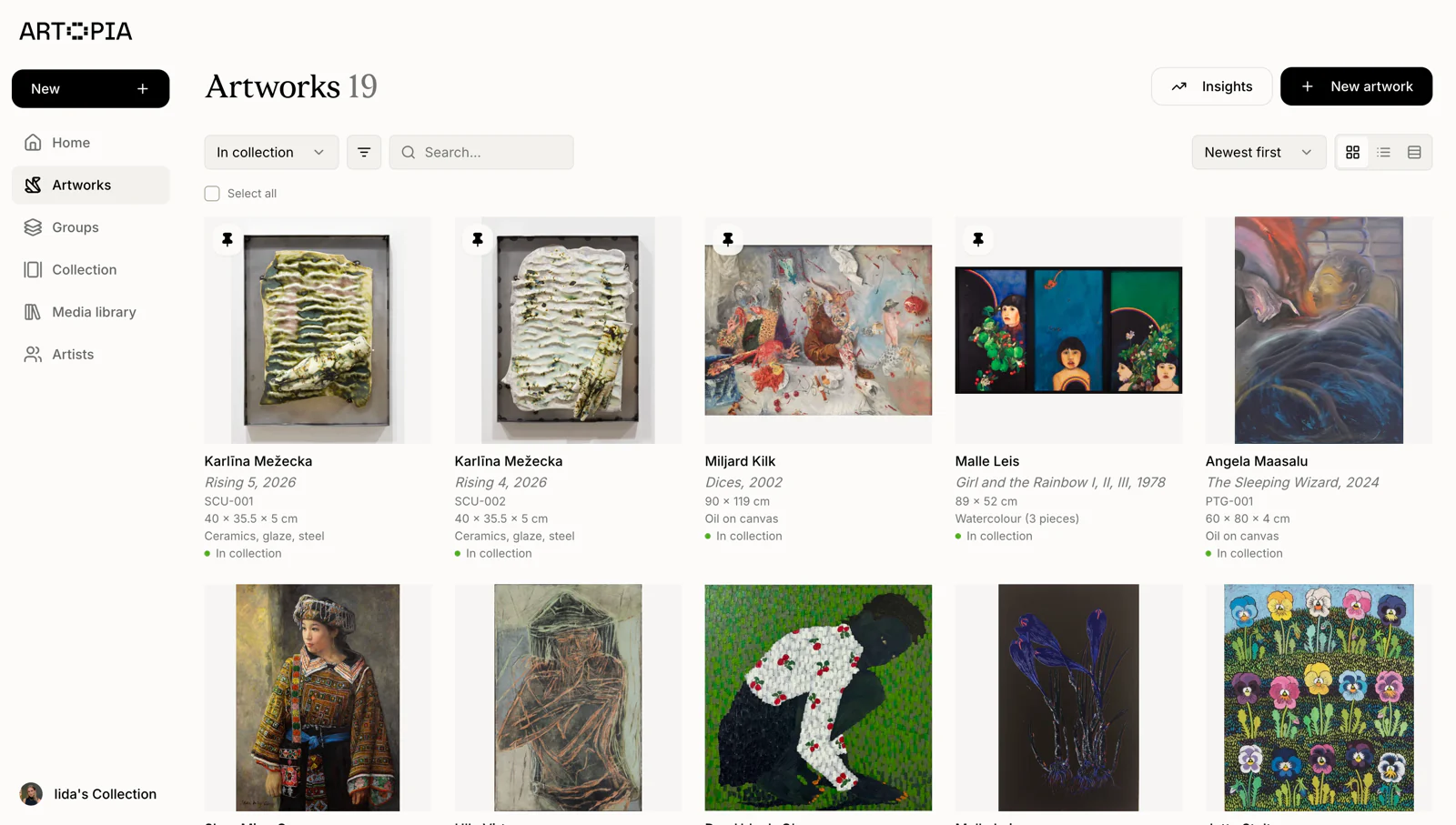
Artopia gives collectors a structured inventory where every work has its own record: artist, title, date, medium, dimensions, acquisition details, valuation, provenance, condition notes, and attached documents. When an insurer asks for a schedule of works with insured values, you can produce it from your Artopia inventory rather than assembling it from scattered invoices and memory.
The total insured value question, which many collectors struggle to answer accurately, becomes straightforward when your collection records are current. Artopia keeps valuations alongside each artwork record, so you can see at a glance what your collection is worth and whether the figure your policy reflects is still accurate.
Artwork records in Artopia include fields for acquisition details and valuation, with document storage for invoices, certificates, appraisals, and condition reports attached directly to the work they relate to. When a new appraisal comes in or a work is acquired, the record is updated in one place, and the information is there when you need it.
If you're managing a collection and your insurance documentation lives across email folders, filing cabinets, and memory, it's worth putting it somewhere more organised before you need it. Start your free trial and have your full collection, valuations, and documents in one place.
Art insurance is one of those areas where the cost of getting it wrong is high and the cost of getting it right is modest. The documentation that makes insurance work, which is the same documentation that makes a collection legible, manageable, and transferable, is worth building early and maintaining consistently.