Provenance is the documented ownership history of an artwork: a record of who has owned it, when, and how it changed hands. For a work bought directly from a living artist, provenance may be a single line. For a work that has passed through galleries, auction houses, estates, and private collections over decades or centuries, it can be a detailed chain of custody reaching back further than living memory.
Collectors often encounter the word provenance in sale catalogues or insurance forms and treat it as someone else's concern. It isn't. The provenance of what you own affects its value, its insurability, its legal status, and your ability to sell or lend it. Understanding what provenance is, how to document provenance correctly, and what it requires from you is part of responsible collection management, alongside the broader work of cataloging and documenting your collection.
What is provenance in art collecting?
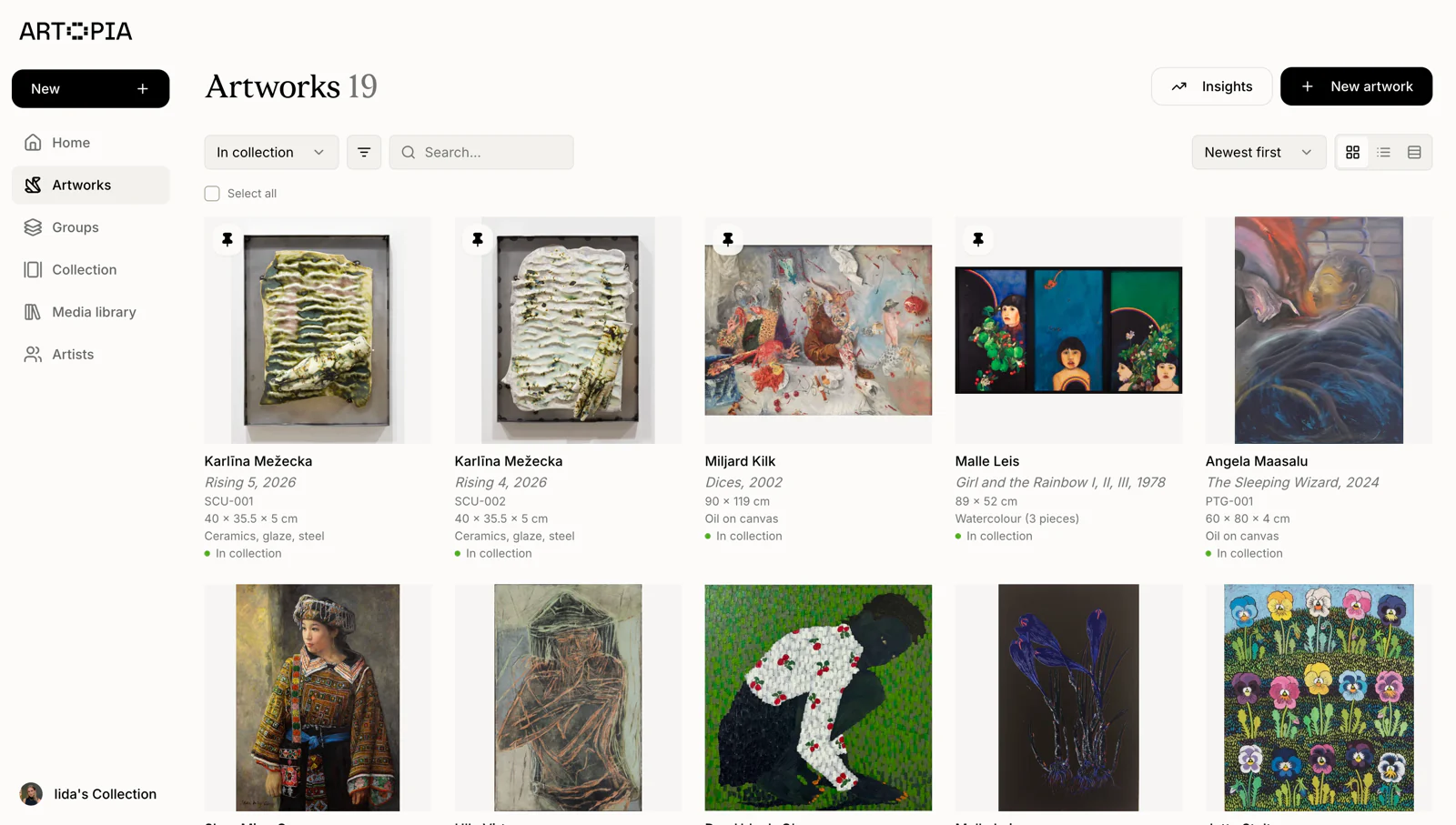
Provenance in art collecting is the verified record of an artwork's ownership history from its creation to the present. It typically includes the names of previous owners, the dates of each transfer, and the circumstances of each transaction, whether through sale, gift, bequest, or auction. Strong provenance is continuous, documented, and traceable. Gaps or inconsistencies in provenance raise questions that can be difficult to resolve. In collection management software like Artopia, provenance is a dedicated field within each artwork record, not a notes field or an afterthought, because it is treated as structured data that travels with the work.
A simple provenance record for a work with a clear ownership history might look like this:
Artist Name, Title, Year
- Acquired by the present owner from [Gallery Name], New York, 2022
- Sotheby's, London, “Contemporary Art Evening Sale”, 15 October 2019, lot 42
- Private collection, London (acquired 2010)
- Gagosian, New York (acquired directly from the artist, 2008)
Each line represents a documented transfer. Read from bottom to top, the record traces the work from the artist's studio to its current owner. Where a line cannot be filled in, the gap is noted rather than skipped.
Why provenance matters to private collectors
The conversation about provenance often centers on museums and auction houses, but private collectors have equally concrete reasons to pay attention.
Resale value. When a work comes to market, buyers and their advisors will ask about its history. A well-documented provenance supports the asking price. Gaps, on the other hand, create uncertainty that suppresses value and can make a work harder to place with reputable galleries or auction houses. This is true even for relatively recent works.
Insurance. In the event of loss, theft, or damage, insurers use provenance records alongside photographs and valuations to process claims and verify ownership. Works without clear documentation are harder to insure and harder to recover. Stolen art databases, including the Art Loss Register, cross-reference provenance records when works are recovered or re-offered for sale.
Authentication. For works not covered by a catalogue raisonné, or where attribution is debated, ownership history is often the strongest available evidence. A work that can be traced to a known collection, an exhibition, or a gallery closely associated with the artist carries weight that a work appearing from nowhere does not.
Your own understanding. There is also a less transactional reason. The history of a work is part of what it is. Knowing that a painting was in a particular collection, or appeared in a specific exhibition, or passed through a certain period of an artist's own lifetime adds something to how you understand the object. Provenance isn't just paperwork.
What provenance documentation looks like in practice
Provenance is assembled from whatever records exist. For contemporary acquisitions, the documentation is usually straightforward and comes with the work. For older works, it requires research. In either case, the goal is the same: each document type below should be stored alongside the artwork record it relates to, not in a separate system where it can become disconnected from the work over time.
Documentation that contributes to provenance includes:
Purchase records. Invoices, receipts, and auction records establish a transaction: who sold, who bought, at what price, and when. For works acquired from galleries, the invoice is the starting point for your provenance record. Keep originals and scans, stored alongside the artwork record rather than in a separate folder.
Exhibition records. When a work appears in a public or institutional exhibition, it enters the documented record. Exhibition catalogues, loan agreements, and condition reports issued at the time of a loan all contribute to provenance. If a work you own appeared in an exhibition before you acquired it, that entry in a catalogue is evidence.
Previous sale records. Auction house records are largely public. Christie's, Sotheby's, Bonhams, and most major houses maintain searchable archives of past sales. If a work passed through auction, the lot entry, the estimate, and the hammer price are documented. This is one of the more reliable sources for tracing ownership between private hands.
Estate and succession records. Wills, inventories, and probate records can establish ownership across generations. For European works with long histories, these sources are often the only way to establish continuity through periods where no commercial transaction occurred.
Correspondence and archival records. Letters between collectors, dealers, and artists; gallery stockbooks; artist estate records; and institutional archives can all document provenance. This kind of research is more specialised and is usually only warranted for works of significant value or uncertain attribution.
Labels and inscriptions. The verso of a work often carries physical evidence of its history: gallery labels, auction stickers, collection stamps, inventory numbers, exhibition labels. These should be photographed and noted in the record. Labels are not infallible (they can be removed or added) but they are part of the physical evidence.
How to document provenance for works you already own
For works acquired with clear documentation, the task is straightforward: record what you have, attach the relevant documents to the artwork record, and note any gaps.
For works where the provenance record is incomplete, the approach depends on how significant the gap is and what the work is worth.
Start with what you have. Gather whatever documentation exists at the time of acquisition or now. The invoice, any provenance statement provided by the seller, photographs, certificates, and exhibition records. Even a partial record is more useful than none.
Research backwards from the sale. If you acquired the work from a gallery or auction house, ask what provenance documentation they hold. Reputable sellers retain records and will share them. Auction house lot notes often include prior provenance research, which you can use as a starting point.
Check public records. For works that have been at auction, search the major auction house databases. For works that appeared in exhibitions, check museum and gallery archives where accessible. For works by artists with active estates or official authentication bodies, contact the relevant foundation directly.
Note the limits of what you know. A provenance record that honestly identifies where the chain of ownership is unclear is more useful, and more credible, than one that papers over gaps. Write down what you know, when you know it from, and where the record ends. "Acquired by the current owner from [gallery], [date]. Prior history unknown" is a legitimate provenance statement. It is less reassuring than a complete history, but it is honest.
For works with significant value or complex histories, consider specialist advice. Provenance research for collectors dealing with older works, disputed attribution, or incomplete records is a specialised field. Organisations including the Art Loss Register and provenance research services associated with major auction houses can assist when standard approaches don't resolve the gaps.
I was featured in a publication: what should I record?
If a work in your collection is mentioned in a publication, catalogue, or press coverage, record the full citation alongside the artwork: the publication name, date, page number or URL, and the nature of the reference. If you have a physical copy of the catalogue, keep it. These records contribute to the exhibition and publication history of the work, which is part of its provenance, and they increase the work's documented presence over time. For a full breakdown of what to capture, see how to manage press records for your art collection.
Provenance and due diligence before acquisition
The time to research provenance is before you buy, not after. For most contemporary acquisitions from established galleries, the provenance is clear and due diligence is minimal. For older works, works from private estates, works with gaps in the record, or works offered at prices that seem surprising given the claimed history, more scrutiny is warranted.
Checking the Art Loss Register before a significant acquisition is straightforward and inexpensive. It does not resolve all questions, but it is a basic step that responsible collectors take. If a seller cannot provide any provenance documentation for a work of significant age or value, that absence is itself information.
Provenance research for collectors cannot always produce certainty. Many works have passed through periods of war, displacement, or private ownership where records simply do not exist. The standard is not an unbroken chain of documentation from the studio to your wall. It is a reasonable, good-faith effort to establish what can be established, and an honest account of what cannot.
Keeping provenance records up to date
Provenance is a living record. Every time a work changes hands, or is loaned to an institution, or appears in an exhibition or publication, the record grows. Your role as the current owner is to document your own period of ownership so that the next owner has a clean starting point.
That means keeping your purchase records, maintaining exhibition and loan records, noting any conservation work, and ensuring that when a work leaves your collection, the new owner receives the documentation you hold. Thorough art provenance records through your period of ownership, even where earlier history is partial, are the mark of a well-managed collection.
Artwork records in Artopia include a dedicated provenance field alongside document storage, so purchase records, auction lot notes, exhibition catalogues, and certificates can be attached directly to the work they document. When a work moves on or goes to loan, the record goes with it.
What to do if you find a gap in your provenance
Gaps in provenance are common. Most collectors, if they look carefully at their records, will find works where the documentation is thinner than it should be. The appropriate response is not to ignore the gap, but to assess it.
Is the gap in a period or region where ownership is genuinely difficult to trace? If so, consult a specialist. Is the gap simply a missing invoice for a work acquired decades ago from a gallery that no longer exists? That is a different situation, and one where a statutory declaration or written account of the circumstances of acquisition can partially fill the record. Is the gap in the history of a work before your ownership, and does it pre-date any period of concern? Note it, document what you know, and move on.
A gap is a problem only if it is ignored. Acknowledged, documented, and researched to the extent possible, it is simply a fact about the work's history.
Provenance is not the most visible part of collecting, but it is one of the most consequential. The records you keep, and the research you do before you acquire, determine how well-protected you are, how easily you can sell or lend, and how clearly the works in your collection speak for themselves. It is worth taking seriously from the beginning, and worth catching up on if you haven't.
Artopia is built for collectors who want their records to be in order: structured artwork records, document storage, and the kind of organised inventory that makes provenance research and documentation straightforward rather than an afterthought. Try it free.