Getting featured in an art publication is a meaningful moment for any collector. Whether it's a collection profile in an art publication, a spotlight in a regional arts journal, or a feature from an emerging curatorial platform, these appearances are part of your collection's history. They document how your collection has been seen, discussed, and placed in a broader cultural conversation.
Most collectors have no system for tracking press coverage of their art collection. Links get bookmarked and forgotten. PDF clippings end up in downloads folders. Print issues sit on a shelf without any record of what they contain. When a gallerist asks what coverage your collection has received, or when a journalist wants to know about previous features before writing their own, the information is there somewhere, just not findable.
This guide covers what press tracking means for collectors, why it matters, and how to manage it as part of your collection records.
What is press documentation for an art collection?
Press documentation for an art collection is the practice of recording, storing, and organizing any publications, articles, features, or media appearances that reference your collection. This includes print and digital magazine features, collection profiles, artist spotlights that mention your holdings, podcast appearances, curatorial essays, and exhibition catalogue entries. For each feature, collectors should record the publication name, date, URL, and a note on which works were mentioned, then store that record alongside their artwork inventory.
Collectors who maintain press documentation have a complete record of how their collection has been received over time. This record serves practical purposes (insurance, estate planning, collection valuation) and narrative ones (understanding the story of the collection as it has been told publicly).
Why getting featured matters
Press coverage isn't just a record of recognition. For many collectors, it's an active part of how they engage with the art world and contribute to it.
It creates visibility for the artists you collect. When a publication features your collection and highlights specific works, the artists behind those works get exposure they might not otherwise have. That visibility can translate into broader interest, gallery attention, and stronger demand for their work. Collectors who are thoughtful about the artists they champion can use press coverage as a way to actively support those careers, not just document their own.
It builds your platform as a collector. A profile in a respected publication establishes credibility. Over time, a collector with a documented public presence gets invited into conversations that would otherwise be closed: panel discussions, advisory roles, collector forums, and curatorial dialogues. These opportunities compound. Each feature makes the next invitation more likely, and each public appearance gives you a place to share your perspective on collecting, the artists you believe in, and the direction you see the field moving.
It encourages others to collect. Collector profiles are one of the most effective ways to demystify what collecting actually looks like. When someone reads about how you started, what drew you to particular works, and how your collection has developed, it makes the whole practice feel more accessible. That matters for the field. More collectors means more artists supported, more galleries sustained, and a broader cultural conversation about what private collections can contribute.
Art publications feature private collections for these reasons, and more. A collector who has built a focused, coherent body of work around an artist or theme becomes a reference point. Publications like Artsy, Artnet News, and regional arts journals regularly profile significant private collections, both to document the field and to give readers insight into how collections are formed. Collector-focused outlets such as Art Collector News, Larry's List, and Art Collector are dedicated specifically to this kind of coverage, with profiles and interviews that reach audiences who are actively interested in private collections.
Beyond major international publications, smaller features matter too: a local arts supplement, a museum donor profile, a gallery newsletter, an art fair catalogue that includes a collector interview. These are less visible but equally part of the record.
For collectors who are building over decades, press documentation becomes a kind of institutional memory. It captures who noticed the collection, at what point in its development, and how it was described. That context is difficult to reconstruct later if records are not kept from the start.
I was featured in a publication: what should I record?
If your collection has just been featured somewhere, add the record while the details are fresh. Note the publication name, the article title, the date it went live, and the direct URL. Add a brief note on what the feature covered: whether it was a full collection profile, a mention of specific works, or an interview with you as a collector. If particular artworks were highlighted, note which ones so you can cross-reference the feature against your artwork inventory later.
Save a PDF of the article alongside the link. Online features can disappear, move behind paywalls, or have their URLs changed without notice. A saved copy ensures the record stays intact regardless of what happens to the original page.
That's the complete record for a single press feature. Stored consistently each time, these entries build into a chronological history of your collection's public presence.
What to track for each press feature
For each publication or feature, there are a few core fields worth recording:
Publication name. The outlet where the feature appeared. Artsy, Artnet, a specific magazine title, a gallery blog.
Title of the article or feature. The exact headline or section title as published.
Date. Month and year of publication, or the full date if available. For ongoing features or profiles that are updated over time, note when you first appeared and when updates occurred.
URL or digital reference. For online features, the direct link. Note that online articles can disappear or move, so storing a saved copy or PDF alongside the link is good practice.
Type of coverage. A brief note on the nature of the feature: collection profile, artist interview that references your collection, exhibition review mentioning a loan, publication of a work from your holdings.
Specific works mentioned. If the feature references particular artworks from your collection, noting which ones creates a useful cross-reference between your press record and your artwork inventory.
Journalist or author. The name of the writer, critic, or curator who wrote the piece.
Physical copy location. If the feature appeared in print and you have the issue, where is it stored?
These fields are enough to make a press record useful. You can find a feature quickly, know what it covered, and trace which works in your collection have received the most attention.
Common situations where press records become useful
When speaking to a journalist. A journalist writing a new feature on your collection will often ask what coverage it has received before. Having a clear list of previous features, with dates and publications, makes that conversation easy and positions the collection professionally.
When lending a work for exhibition. Institutions sometimes ask about the provenance and publication history of specific works. If a work from your collection has been featured in a publication, that adds to its record.
Insurance and valuation. Press coverage can be relevant to collection valuation, particularly for artworks that have been specifically highlighted in significant publications. Appraisers and insurers occasionally factor cultural visibility into assessments.
Estate planning and collection transfer. If the collection passes to heirs, an institution, or a foundation, having a complete press record is part of the handover documentation. It tells the story of the collection in a way that inventory records alone do not.
Verifying your collection's public footprint. Over time, it's easy to lose track of where the collection has appeared. A maintained press record gives you a clear picture of the collection's public history without relying on memory or incomplete bookmarks.
Managing press features alongside your collection records
The most practical approach is to keep press documentation in the same system as your other collection records. A collection management tool that separates press from artwork data requires you to manually cross-reference the two. A system where press records live alongside inventory, documents, and provenance records keeps everything in one place.
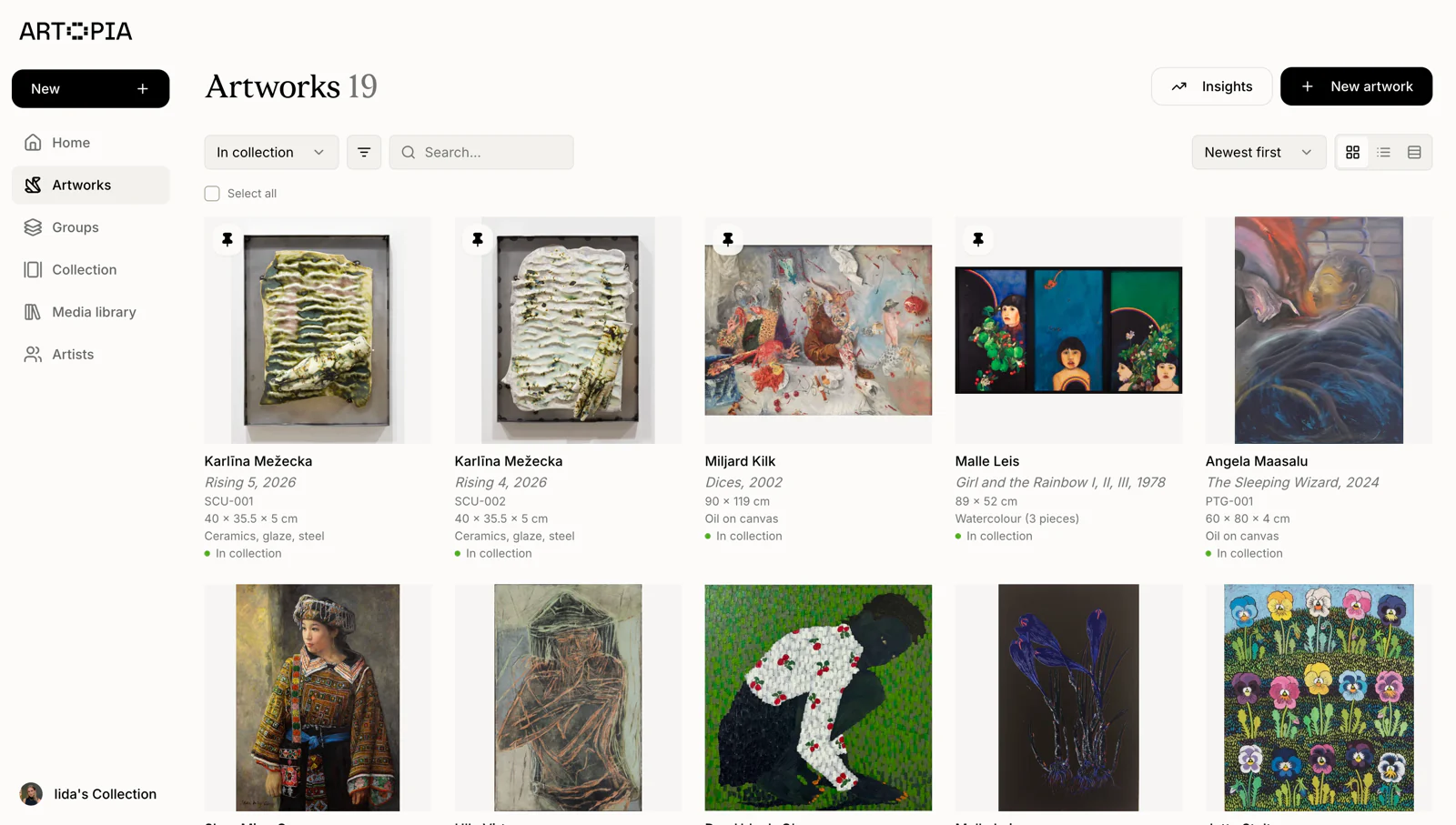
In Artopia, collectors can add press features directly to their Collection page through a dedicated Press section. Each entry holds the publication name, title, date, URL, and notes about the feature. This keeps press documentation connected to the rest of the collection record, rather than scattered across separate folders, browser bookmarks, or email threads.
Adding a feature takes under a minute: title, publication, date, and a link. Over time, the Press section becomes a chronological record of the collection's coverage without requiring any additional organization effort.
A note on digital publications and link decay
Online articles are not permanent. Publications change their URL structures, archive content behind paywalls, or remove old features entirely. A link that works today may return a 404 in three years.
For any press feature you want to preserve, save a PDF or screenshot alongside the URL when you add it to your records. Most browsers offer a "save as PDF" option directly from the print menu. This takes thirty seconds and ensures the feature remains accessible regardless of what happens to the original publication's site.
For print features, scanning the relevant pages or photographing the spread is worth doing once, when the issue is fresh. Physical magazines are harder to store long-term and easy to lose track of.
Building the habit
Press features don't arrive on a schedule. A profile might come once a year, once every few years, or in a cluster around a significant acquisition or a loan to a high-profile exhibition. Because they're infrequent, the temptation is to log them "later" and then not get to it.
The simplest approach: add each feature to your records within a week of publication. Set a brief reminder when you know something is going live. If you receive a PDF from the journalist or a link from the publication, add that directly to your press record before the email thread gets buried.
Collectors who maintain accurate, up-to-date collection records, including press documentation, have a significant advantage when they need to present their collection to institutions, insurers, or buyers. The records don't take long to keep; they just require a consistent habit.
Keeping press records as part of a broader collection management practice
Press documentation sits within a broader set of collection management practices that include artwork cataloging, provenance tracking, condition records, and document storage. These aren't separate activities. They all contribute to a complete picture of the collection. If you're building out those foundations, the guide on how to catalog and document your art collection covers what to record for every artwork and how to structure those records over time.
If your collection records are currently split across spreadsheets, folders, and bookmarks, that's worth addressing before the collection grows further. The earlier you establish a single place for everything, the less reconstruction you'll need to do later.
Artopia is built for private collectors managing collections of any size. The platform covers artwork records, documents, location tracking, and press features in one place, without the complexity of institutional systems designed for museums or galleries. It's the kind of art collection management tool that keeps everything connected rather than scattered. You can start for free and build out your collection records at your own pace.
Summary
Tracking press coverage for your art collection is worth doing from the first feature. Press documentation gives collectors a clear history of how their collection has been seen over time, supports practical tasks like valuation and estate planning, and makes conversations with journalists, institutions, and advisors easier. The fields to track are simple: publication, title, date, URL, type of coverage, and works mentioned. The key is keeping that record in the same place as your other collection data, so it stays connected and findable.