Inheriting art creates immediate questions around valuation, insurance, taxes, provenance, storage, and documentation. Whether you have inherited a private collection or the estate of an artist parent, the first priority is understanding exactly what you have and creating a reliable inventory.
This guide explains the practical steps to take, the legal and financial issues that may arise, and how to document inherited artwork properly.
First steps after inheriting art
Before anything else, work through these steps in order:
- Photograph every artwork, front and back, including any labels, stamps, or inscriptions
- Separate framed works, unframed works, and anything in storage
- Gather receipts, certificates of authenticity, correspondence, and exhibition records
- Record dimensions, signatures, medium, and condition for each piece
- Create a digital inventory of all inherited artwork
- Obtain preliminary valuations from a qualified appraiser
- Review your insurance coverage and notify your insurer
- Consult estate or tax professionals if the collection has significant value
Inheriting a collector's collection
When a collector passes away, their accumulated artwork and holdings often transfer to family members who had little involvement in building them. The inherited paintings, sculptures, or works on paper may span different artists, periods, and mediums. The paperwork, if it exists, may be scattered across email threads, physical folders, or nowhere at all.
The first challenge is establishing what you actually have. Many inherited art collections arrive with partial records. Purchase receipts may be missing. Provenance chains may be incomplete. Some works may have been acquired informally, without documentation of where they came from or what was paid.
This matters for several reasons.
Insurance exposure starts immediately. The moment ownership transfers, you are responsible for the inherited artwork. If no current valuation exists and no inventory has been prepared, you may be uninsured or underinsured without realizing it. Household contents policies rarely cover art collections adequately, and specialist art insurance requires documentation to issue coverage at the right level.
Tax obligations may create a deadline. Depending on your jurisdiction, inherited art may require a formal appraisal for estate tax purposes within a defined window after the date of inheritance. Even where this is not legally required, establishing the fair market value at the time of inheritance creates a cost basis that matters if you sell any works later. An undocumented collection makes valuing inherited art harder and sometimes more expensive.
Authenticity questions may surface. Collections assembled over many years sometimes include works with murky histories, particularly pieces acquired before provenance standards became common practice. Cataloging inherited artwork often brings these questions into view for the first time. That can feel uncomfortable, but it is better to know early.
Decisions cannot be made well without a clear picture. If you are considering keeping certain works, selling others, donating to an institution, or loaning to exhibitions, none of those decisions are straightforward without first knowing what you have, what it is worth, and what documentation exists. The inventory is not the last step. It is the first one.
Inheriting a relative's artwork
When the person who made the work is the one you have lost, the inheritance is different in character. You are not managing a collection of acquisitions. You are managing an artist estate, often with its own internal logic and history.
Managing an artist estate presents a distinct set of practical questions.
The studio inventory is often informal. Many artists kept their own records, but rarely to a standard that transfers cleanly to an estate. Inherited paintings may be finished, partially finished, or studies with no clear status. There may be editions, prints, or multiples that exist in quantities you are not yet aware of. The first task is a complete inventory of what physically exists and what state each piece is in.
Copyright transfers with the estate. In most jurisdictions, an artist's copyright in their work passes to their heirs, usually for a period of 70 years after the artist's passing. This means you now control reproduction rights, licensing, and the use of images. Many families are unaware of this until someone approaches them about using an image or reproducing a work. Documenting an art collection properly from the start makes it possible to manage these requests accurately.
Authentication becomes a long-term concern. If the artist's reputation grows after their passing, which is not uncommon, the value of individual works can increase significantly. Forgeries become more viable as a result. A well-documented artist estate, with clear records of each work's history, condition, and provenance, provides the basis for authentication decisions later. An undocumented estate is more vulnerable to disputes.
Foundation or estate structures may be relevant. Some families establish foundations to preserve and promote an artist's legacy. Others simply manage the works privately. Either way, documentation has to come before structure. You cannot make good decisions about the future of the work without first understanding what exists.
The emotional dimension is real. These are not objects someone purchased. They are the evidence of a life's work. Many heirs feel a sense of responsibility that goes beyond practical management. Documenting inherited artwork is a form of preservation, not just administration. A complete record means the work can be understood and talked about accurately for years to come.
Storage and conservation after inheriting art
One of the most common and costly mistakes heirs make is mishandling inherited artwork before professional advice is sought. Works can suffer irreversible damage in the days or weeks after an estate transfer.
A few basic principles:
Avoid direct sunlight. UV light fades pigments and degrades works on paper quickly. Keep inherited paintings away from windows until proper display or storage conditions can be arranged.
Avoid attics and basements. Extreme temperature fluctuations and humidity cause paint to crack, canvas to warp, and paper to deteriorate. Climate-controlled storage is the standard for a reason.
Do not clean paintings or works on paper. Well-intentioned cleaning can cause permanent damage. Leave surface dirt in place until a conservator can assess the work.
Document condition before moving anything. Photograph every work before it is transported. Note any existing damage, cracks, tears, or areas of concern. This record matters for insurance claims and future conservation assessments.
If you have inherited a large or valuable collection, a conservator can conduct a condition survey and advise on storage priorities before anything is moved.
What both situations have in common
Whether you have inherited an art collection or an artist's estate, the starting point is the same: build an inventory of inherited artwork.
That means recording each work with as much detail as you have available. Title, medium, dimensions, date, condition, any provenance information, any documentation you can locate. Photographs of the front, back, and any identifying marks. Notes on anything unusual or uncertain.
This record becomes the foundation for everything that follows: insurance, valuing inherited art, tax reporting, future sales, loans, donations, and authentication. It also gives you a way to think clearly about what you have and what you want to do with it.
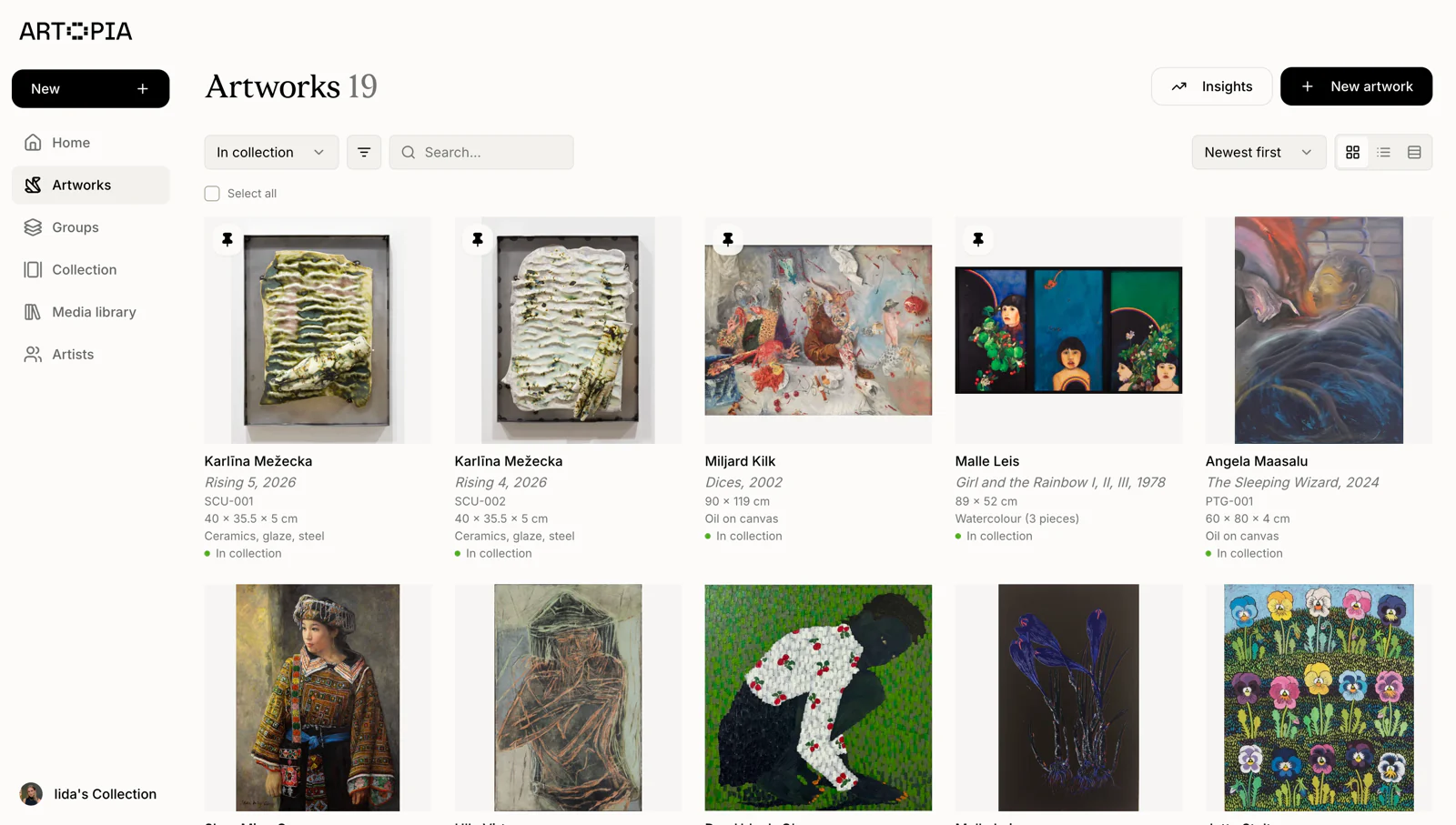
Once the initial uncertainty settles, most heirs need a practical system for organizing records, photographs, provenance documents, valuations, and condition notes in one place. Artopia helps collectors and artist estates build structured digital inventories, manage documentation, and export records for insurers, appraisers, and advisors. You can start by signing up here.
For more on the topics covered in this guide, see art insurance for private collectors, which covers how to document a collection for specialist coverage, and our guides on provenance, condition reports, and how to catalogue your art collection.
Frequently asked questions
Do I need a professional appraiser when I inherit art?
For insurance and estate tax purposes, a formal appraisal from a qualified appraiser is usually necessary. Your own inventory records are not a substitute for a professional valuation, but they make appraising inherited art faster and more accurate by providing a complete list of works and any existing documentation.
What happens to copyright when an artist passes away?
In most countries, copyright passes to the artist's heirs and lasts for 70 years after the artist passes. As an heir, you control reproduction rights, licensing, and how images of the work are used commercially.
How do I find out if inherited works have provenance gaps?
Start with whatever documentation exists: receipts, correspondence, exhibition catalogues, auction records. Gaps become visible when you build a full inventory and compare it against the records you have. For significant works, an art advisor or specialist researcher can help trace ownership history.
Can I use standard home insurance for inherited art?
Most standard home or contents policies are not designed to cover inherited art collections adequately. Coverage limits are often too low and conditions around storage and transit may not apply. Specialist art insurance typically requires an inventory and current valuations to issue appropriate coverage.
What if I do not know much about the art I have inherited?
Start with what you can observe and record. Photograph everything. Note any signatures, inscriptions, or labels on the back of works. Gather any paperwork you can find. A conservator, appraiser, or auction specialist can help with identification once you have a documented starting point.
How should I store inherited artwork?
Keep works away from direct sunlight, attics, and basements. Stable temperature and humidity are critical for long-term preservation. Do not attempt to clean paintings or works on paper before consulting a conservator.