Artopia and Art Record are both platforms for organising and documenting art, but they are built around different people. Art Record was developed with and for artists and estates, with collection management added as a secondary offering. Artopia is built specifically for private collectors.
If you are a collector evaluating both, this comparison covers what each platform does, what it costs, and where the differences matter.
What is the difference between Artopia and Art Record?
Artopia is a collection management tool built for people who collect art. Art Record is an archive and inventory platform built for artists and estates managing a body of work, with a separate galleries and collections product for other users.
Both platforms handle artwork records, images, and document storage. The difference lies in focus. Art Record's feature set reflects the needs of studios and estates: exhibition histories, press archives, consignment tracking, sales contacts, and high-volume file storage for formats ranging from video and audio to 3D files. Artopia's feature set reflects the needs of collectors: provenance, acquisition records, valuation, shareable collection views, and clean documentation.
Artopia vs Art Record: A quick comparison
| — | Artopia | Art Record |
|---|---|---|
| Built for | Private collectors | Artists, estates, galleries |
| Starting price | Free (up to 50 artworks) | From $33/month (artists) |
| Free plan | Yes, no time limit | No (30-day trial only) |
| Provenance tracking | Yes | Yes |
| Document storage | Yes | Yes (80+ file formats, 1TB) |
| Shareable collection view | Yes | Yes (customisable links) |
| Exhibition archive | No | Yes |
| Sales and consignment tracking | No | Yes (galleries plan) |
| Press and publications archive | No | Yes |
| Contact management | No | Yes |
| Learning curve | Low | Moderate |
| Best for | Collectors who want a focused, private tool | Artists, estates, and galleries managing an active practice |
Artopia
Artopia is an art collection management platform built from the ground up for private collectors. The feature set, interface, and pricing all reflect a single audience: people who collect art and want a reliable, clean place to document what they own.
What Artopia does well:
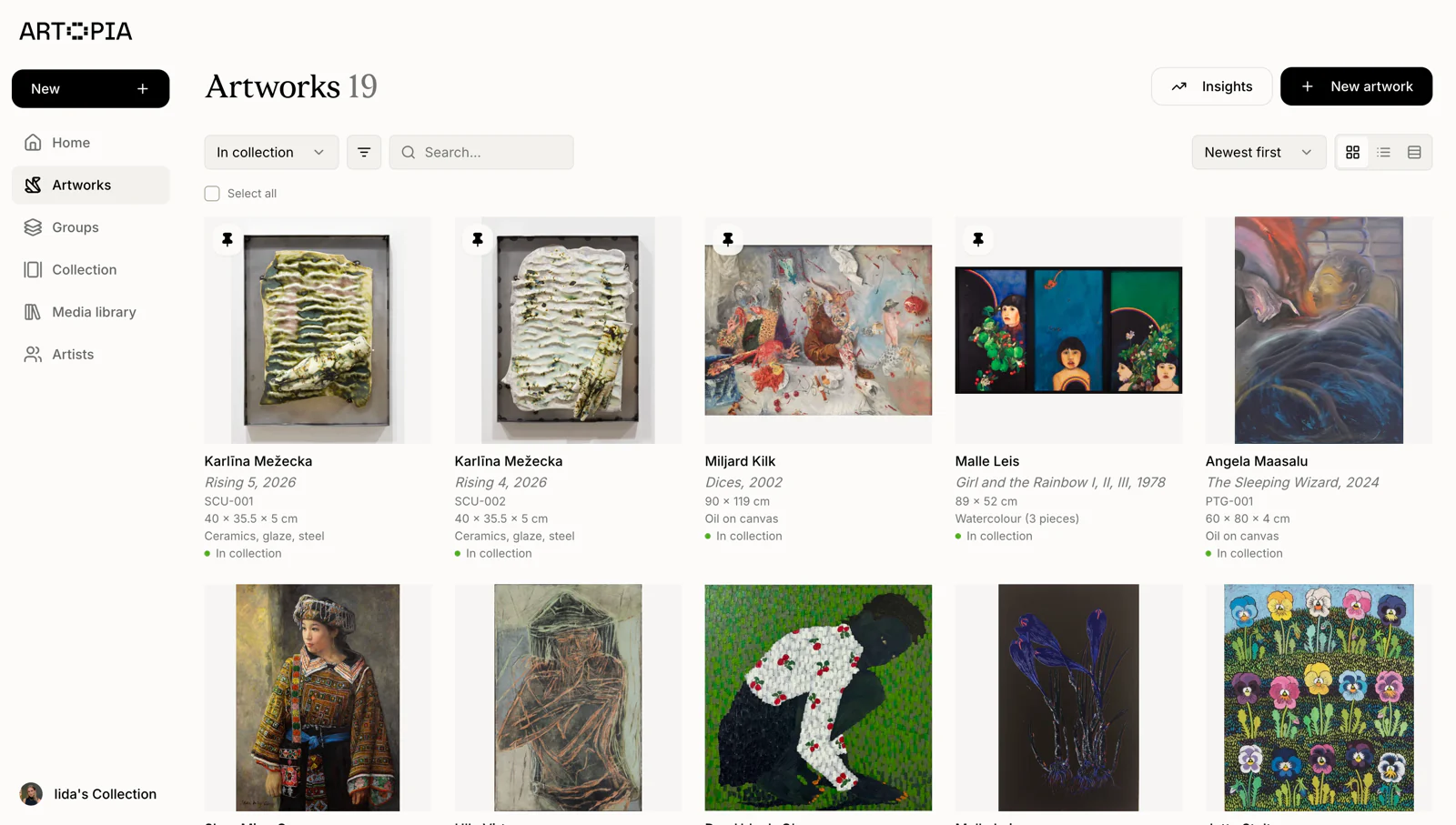
Each artwork record holds everything relevant to that piece: title, artist, dimensions, medium, acquisition details, location, provenance, condition, and attached documents including certificates of authenticity and receipts. You can upload multiple images per artwork and share a public or private view of your collection with a link.
Because Artopia is designed for collectors only, there is nothing in the interface you do not need. No exhibition management, no sales contacts, no press archives. The platform is deliberately focused, which makes it faster to learn and easier to use day to day.
Artopia offers a free tier with no expiry date, supporting up to 50 artworks. Paid plans cover larger collections and additional features.
Where Artopia has limitations:
Artopia focuses on the core features collectors need, which means some of the more niche functionality is not yet included. There is no contact management or exhibition archive, for example. The platform is actively developed and welcomes feature requests. If something is missing that matters to your workflow, you can reach out and suggest it.
Pricing: Free tier available with no time limit (up to 50 artworks). See full pricing.
Best for: Private collectors who want a focused, easy-to-use platform without paying for studio and business features they will never use.
Start managing your collection with Artopia
Art Record
Art Record launched in 2018, developed in close collaboration with a group of artists across a wide range of practices, from painting and sculpture to video, performance, and installation. It has since expanded to serve estates, foundations, and galleries internationally.
What Art Record does well:
For artists and estates, Art Record is thorough. The inventory system handles complex bodies of work, with artwork records that include exhibition histories, sales information, and availability statuses. The platform supports over 80 file formats and offers up to 1TB of storage on the artist plan, rising to 1.5TB on the gallery plan, accommodating the large video and audio files that feature heavily in contemporary practice.
The sharing tools are a particular strength. You can share individual works, groups, or entire exhibitions with customised links, controlling exactly which fields and media are visible. For artists communicating with galleries or curators, this is genuinely useful. The galleries and collections plan adds consignment tracking, sales reports, invoice generation, and contact management.
Art Record also offers an in-house migration service for users moving from another database or spreadsheet system.
Where Art Record falls short for private collectors:
Art Record's roots are in artist and studio management, and that shapes the experience throughout. Exhibition archives, press and publications records, consignment tracking, and sales contacts are prominently positioned, adding navigation complexity that most collectors will not use.
The pricing reflects a professional studio or gallery context. The artist plan starts at $33/month and the galleries and collections plan at $68/month, with no free tier and only a 30-day trial. For a private collector who needs artwork records, provenance, and a shareable view of their collection, that is a meaningful ongoing cost for a tool built around someone else's workflow.
Pricing: From $33/month (artists, annual); $68/month (galleries and collections, annual). No free plan.
Best for: Artists and estates managing a body of work, galleries needing consignment and sales tools, and organisations with archival needs that go beyond a standard collection record.
How Artopia stands out for collectors
The distinction that matters most is audience. Art Record serves artists, estates, and galleries. Artopia serves collectors. That shapes every aspect of each product.
No studio or business features. Artopia does not include exhibition management, press archives, or contact tracking. These are not omissions; they are decisions. The platform contains what collectors need and nothing they would have to navigate around.
Free to start, no deadline. Art Record's 30-day trial gives you limited time to evaluate the platform. Artopia's free tier has no time limit. You can build out your collection records, test the sharing features, and decide whether a paid plan makes sense without a clock running.
Built around the collecting experience. Provenance, acquisition records, condition notes, valuation, document storage, and a shareable public collection view are the features that matter to collectors. These are what Artopia is built around.
Personal migration support. If you are moving from Art Record, Artopia supports CSV import and the team will assist you personally. Reach out at app@art-opia.com and they will take care of it.
Which should you choose?
Choose Artopia if you are a private collector who wants software built specifically for the way collectors think about their collections. The free tier, focused interface, and collector-first feature set make it the right choice for anyone whose goal is documenting and organising what they own.
Choose Art Record if you are an artist, estate, or foundation managing a body of work with complex archival needs, or a gallery that needs consignment tracking, sales reports, and contact management alongside inventory. The platform is well regarded among artists and handles the full scope of studio and estate management.
Frequently asked questions
Is Artopia or Art Record better for private collectors?
For private collectors, Artopia is the stronger fit. It is built specifically for collectors, with a focused interface and feature set that does not include the studio and gallery tools that add complexity to Art Record. Artopia also offers a free tier with no time limit, while Art Record requires a paid subscription after a 30-day trial.
Does Art Record have a free plan?
No. Art Record offers a 30-day free trial, after which a paid subscription is required. The artist plan starts at $33/month on an annual subscription, and the galleries and collections plan starts at $68/month. Artopia offers a free tier with no time limit for collections up to 50 artworks.
Can I migrate from Art Record to Artopia?
Yes. Artopia supports CSV import, and the team offers personal help with data migration. If you are moving your collection records from Art Record, contact app@art-opia.com and they will assist you directly.
What does Art Record offer that Artopia does not?
Art Record includes exhibition archives, press and publications records, consignment tracking, sales reports, invoice generation, and contact management. It also supports over 80 file formats and up to 1.5TB of storage, which is relevant for artists working with video, audio, and large-format files. These are features built for artists and galleries. For private collectors, Artopia covers everything you actually need.